Home > Info and Fun > Articles > Top Ten Reasons to Avoid SLS
Top Ten Reasons to Avoid SLS
Stephanie Greenwood
August 15, 2007
There are a lot of rumors out there about Sodium Lauryl/Laureth Sulfate. Is it really a carcinogen like those e-mails say? .What about an endocrine disruptor and skin irritant? What's truth and what's myth? I've written this article to clear up the confusion about the debated chemical. I don't need to spread lies...the truth is scary enough. To make it easy I'm going to refer to Sodium Lauryl Sulfate and its even more evil twin, Sodium Laureth Sulfate from this point forward as SLS.
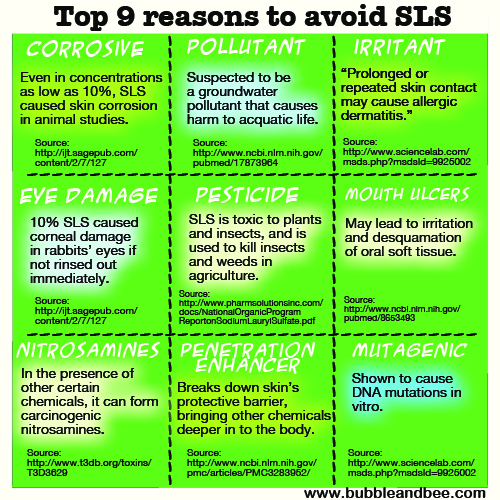
Here are my top ten reasons you should not use anything containing SLS.
1. It is a known skin irritant. When cosmetic companies need to test the
healing properties of a lotion, they need toirritate the skin first. What do they use to do this? SLS, of course. If you have dandruff, dermatitis, canker sores, or other irritated tissues or skin, it could be due to SLS.
2. It pollutes our
groundwater. It is toxic to fish and
other aquatic animals and has the potential for
bioaccumulation
(meaning it accumulates in the bodies of the fish.) It also
is
undetected in many municipal water filters, getting into the tap water
that you drink.
3. It is actually a
pesticide and herbicide. It is commonly used to kill plants and insects.
Makers of
SLS recently petitioned to have SLS listed as an approved pesticide for
organic farming. The application was denied because of its
polluting properties and environmental damage.
4. It emits toxic fumes when heated. Toxic Sodium Oxides and Sulfur Oxides are released when SLS is heated.
Makes a hot shower with an SLS shampoo seem not
quite as
nice...
5.
It has corrosive properties. According to
the American College of Toxicity, this
includes corrosion of the fats and protiens that make up skin and
muscle. SLS can be found in garage floor cleanrs, engine
degreasers, and car wash soaps.
6. Long-term permeation of the body's tissues. A study from the University of Georgia Medicine showed that
SLS
had the power to permeate the eyes, brain, heart, and liver.
7.
It's an eye irritant. It was
shown to cause cataracts in adults, and is proven to inhibit the proper
formation of eyes in small children.
8.
Nitrate and other solvent contamination. Toxic
solvents, including carcinogenic nitrates are used in the manufacturing
of SLS, traces of which can remain in the product.
9.
Manufacturing process is highly polluting, emitting
cancer-causing volatile organic compounds, sulfur compounds, and air
particulates.
10. It helps
other chemicals get into your body. SLS
is a penetration enhancer, meaning that its molecules are so small
they're able to cross the membranes of your body's cells.
Once cells are compromised, they become more
vulnerable to
other toxic chemicals that may be with the SLS.
Does
it cause cancer?
SLS is not a recognized carcinogen itself, but there
is
some truth behind those internet rumors. When SLS is mixed
with
triethanolamine (or T.E.A) carcinogenic substances called nitrosames
can form and be released.
Check out our SLS-Free Shower Gels Here. Not only are they SLS-Free, they're chemical free. No synthetic detergents whatsoever. Just made with saponified organic oils and scented with organic and natural essential oils.
Sources:
NewsTarget
"Popular Shampoos Contain Toxic Chemicals Linked to Nerve Damage" Mike
Adams, January 11, 2005
MSDS
Data Sheet for Sodium Lauryl Sulfate
MSDS Data Sheet
for Sodium Laureth Sulfate
"OCA & Cancer Prevention Coalition Warn of Hidden Carcinogens
in Baby Care" AScribe Newswire, Feb 28, 2007
"Technical Evaluation Report: Sodium Lauryl Sulfate" Compiled by ICF
Consulting for the USDA National Organic Program, February 10, 2006
Environmental Working Group / Skin Deep www.ewg.org/skindeep